Loading...
Lest We Forget, part 3: Harpenden in the Great War: Camp, Hospital and Home Front
Harpenden had no hospital in 1914, so the town's volunteers built one. When the Notts and Derbyshire battalions arrived, the officer commanding the 1st North Midland Field Ambulance asked for local help in nursing the sick.
Part 3 of 13 of Lest We Forget, a history of remembrance in Harpenden and St Albans. Read the whole illustrated book.
Harpenden had no hospital in 1914, so the town's volunteers built one. When the Notts and Derbyshire battalions arrived, the officer commanding the 1st North Midland Field Ambulance asked for local help in nursing the sick. Several local women volunteered and were quickly recognised as a Voluntary Aid Detachment of the St John Ambulance Brigade, with Dr Violet Kelynack as Commandant.
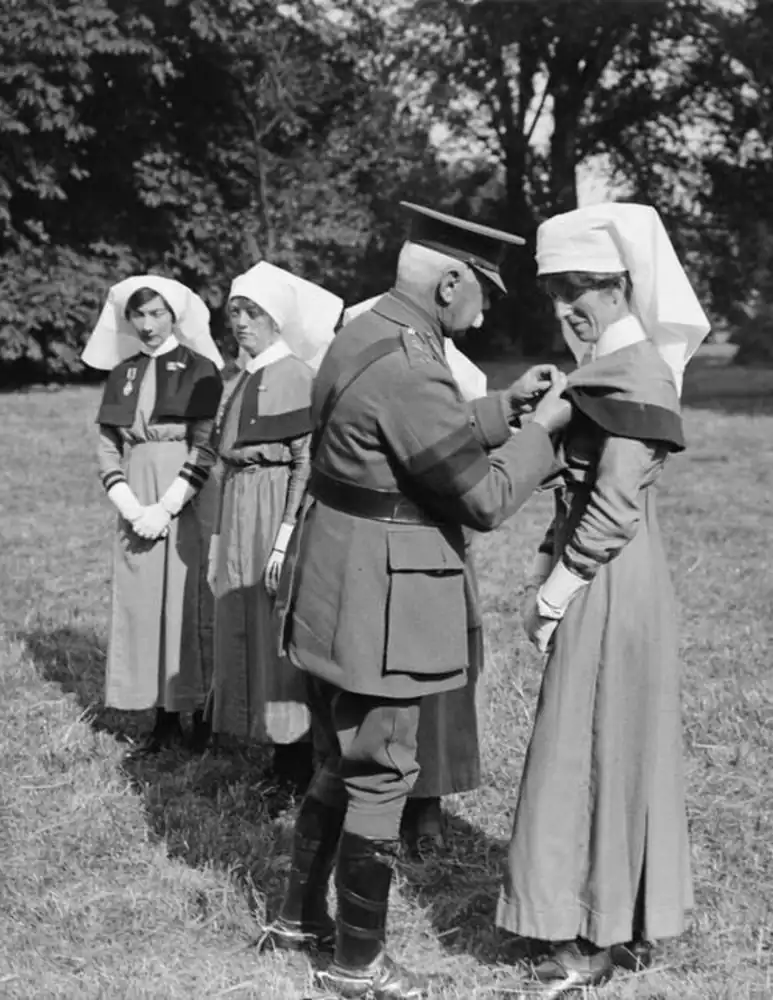
Illustrative: Voluntary Aid Detachment nurses on the Western Front being presented with military medals by General Plumer. Harpenden's volunteer detachment nursed soldiers in the park, the golf clubhouse, the Institute and Rosemary.
Photo: John Warwick Brooke, Imperial War Museums (Q 6772). Public domain.
A hospital on the move
The first wards were tents inside the gates of Rothamsted Park, beside Hatching Green. They were not suited to an English winter, so in October the hospital moved into the golf clubhouse on the Common, and in February 1915 into the Institute, now the Friends Meeting House. In the six months it was there, its 24 beds held 331 patients.
Its first death came within days of opening in the Institute, when a young soldier of the Staffordshire Regiment died of flu. He was buried in St Nicholas churchyard with full military honours. In April 1915, Private Alexander Steel, aged 43, of the 2/6th South Staffordshire Regiment, was found unconscious on the Lower Luton Road after a mysterious accident and died a day later. His funeral procession marched from Milton Road, via Station Road and the Institute, up the High Street to the parish church, led by a band, with the Last Post and a volley at the graveside. His widow and two of their five children attended.
When new troops arrived, Henry Tylston Hodgson, a director of the Midland Railway, offered a house he had built in 1908, "Rosemary" on Milton Road, rent-free. The VAD was given three days' notice. The women cleaned the house, moved in the equipment and received their first patients on 21 October 1915.
- August 1914 to August 1915 October 1915 to May 1916 March 1917 to February 1919 — Tents at Hatching Green, then the golf clubhouse, then the Institute "Rosemary", Milton Road "Rosemary", Milton Road, as an outpost of Napsbury Hospital
The VAD did more than nurse. In its first year, local doctors trained 68 people in first aid, of whom 54 passed the exam, and Dr Kelynack taught three courses in home nursing to 47 students, of whom 42 passed. When the hospital closed temporarily, some nurses moved to hospitals in Luton, St Albans, Hemel Hempstead and Blackmore End, and a few volunteered for hospitals as far away as Chelsea and Malta.
Rothamsted at war
The Rothamsted Experimental Station, then as now one of the town's biggest institutions, felt the war from its first week. Building work on a new laboratory wing began on 9 August 1914, just five days after the declaration of war, and was not formally opened until 21 October 1919. By November 1914, the director, John Russell, had eight soldiers billeted in his study.
Many of its scientists enlisted. Herbert George Martin, a bacteriologist, served in Belgium and died at Ypres on 3 May 1915. Kenneth Lewin, a protozoologist who is also named on the Harpenden memorial, was killed by a sniper while eating breakfast near Ypres on 9 March 1916. Others survived: Athelstan Bowden, a chemistry assistant, was injured at Arras, and Bernard Keen, a soil physicist, served at Gallipoli and in Palestine.
After conscription began in 1916, Russell wrote repeatedly to the local military tribunal seeking exemptions. Chemists were sometimes sent to munitions work instead, including Alfred Appleyard, who worked with Chaim Weizmann on making acetone. Appeals to keep farm staff failed. When the farm manager, Mr Eames, was called up, his wife ran the farm and was said to have made it a profit.
The station also kept a record of its dead. After the war, staff gave about £100 for a memorial tablet by the Arts and Crafts artist W Reynolds-Stephens, which has hung in the main building since 1920.
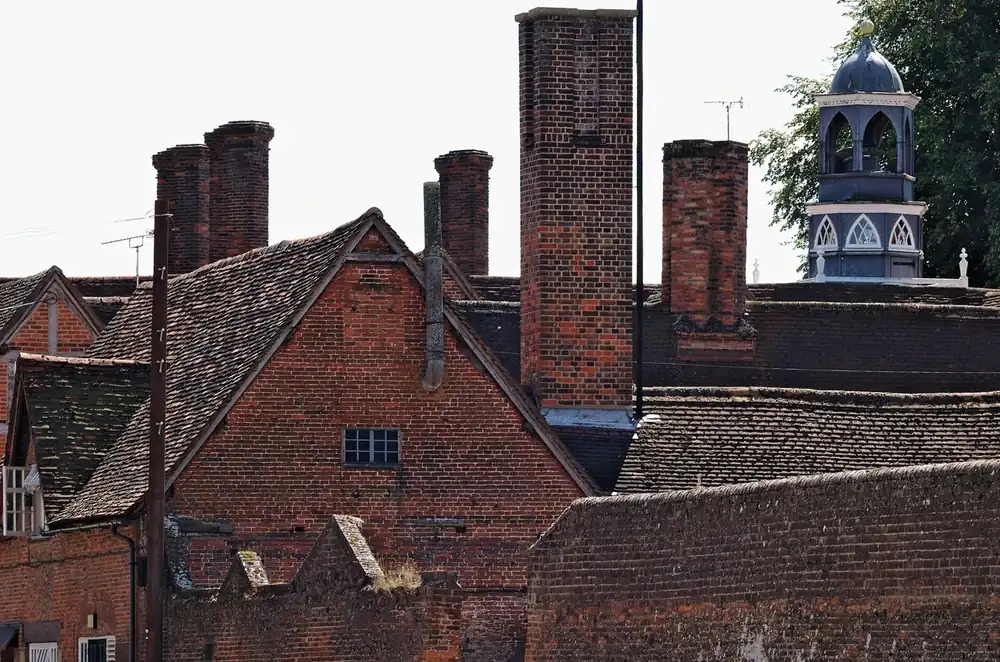
Rothamsted Manor, in the grounds of the experimental station in Harpenden.
Photo: Gary Houston, CC0.
The night of the Zeppelins
Harpenden did not escape the air war. On the night of 2 to 3 September 1916, three or four Zeppelins appeared over the town and dropped bombs on Rothamsted's Broadbalk field, Scout Farm and Hammonds End, leaving an eleven-foot crater in one of the experimental plots. The same raid dropped bombs near St Albans and London Colney. The first airship shot down over Britain, at Cuffley that night, was later cut into souvenirs sold to raise money for the Red Cross.
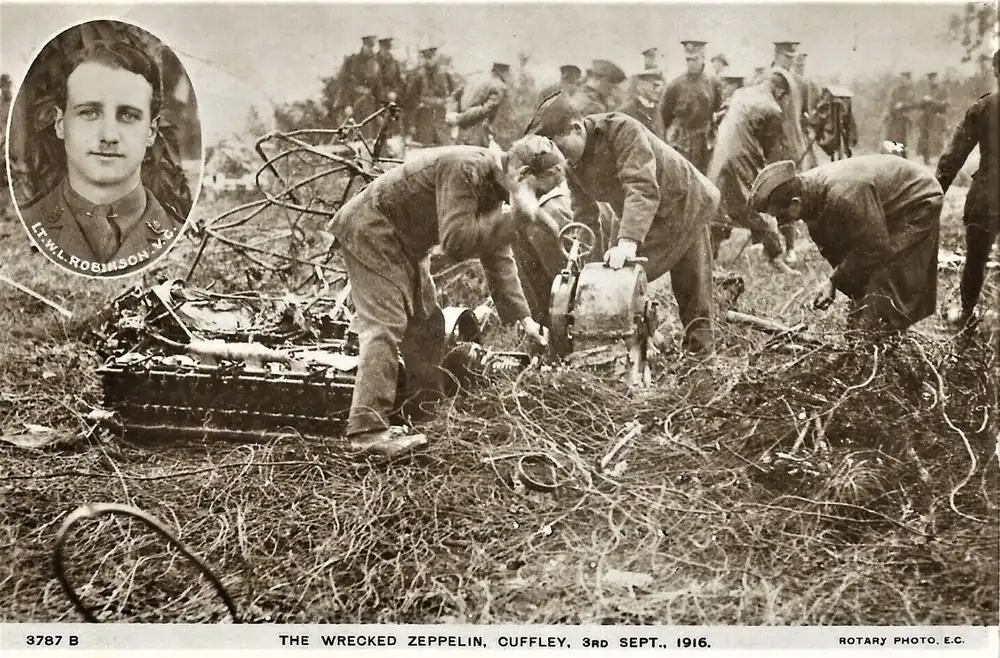
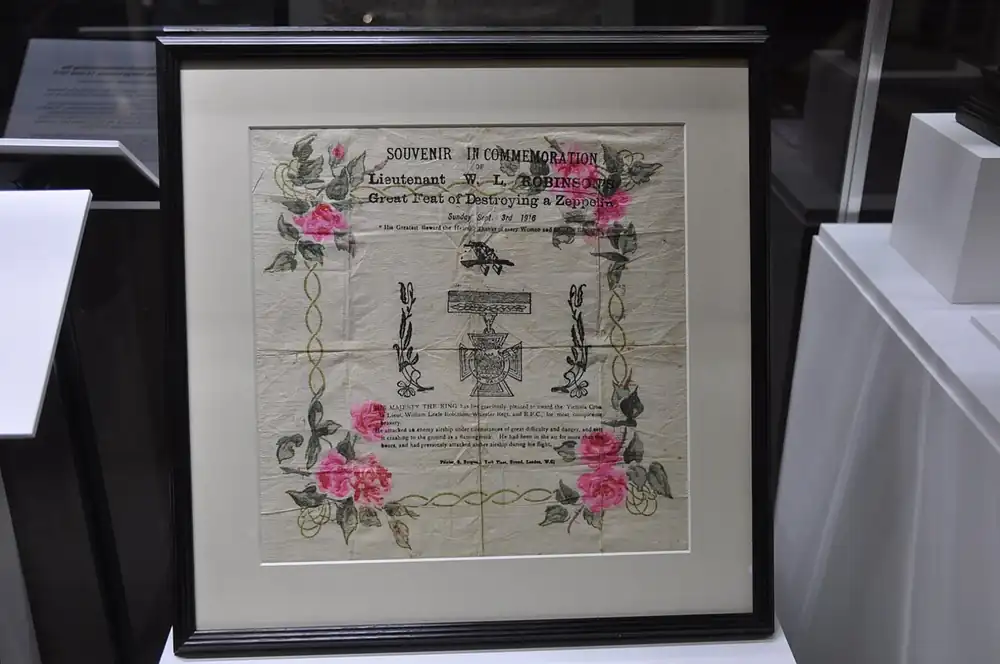
Left: the wreck of the airship at Cuffley, Hertfordshire, after it was shot down on the night of 2 to 3 September 1916 (postcard). Right: a souvenir printed to mark the destruction of the airship by Lieutenant William Leefe Robinson (RAF Museum, Hendon).
Photos: Postcard, 1916, via Wikimedia Commons. Public domain. | RAF Museum souvenir, via Wikimedia Commons. Public domain.
Gallantry and loss
Rothamsted staff won several decorations. Sergeant George Lawrence, the director's gardener, received the Military Medal, and Kenneth McLennan and William Weir won Military Crosses, Weir with a bar. The town's memorial roll lists just as many ordinary lives: a grocer's assistant from Grove Cottages, a miniature painter from Rothamsted Avenue, a postman who also worked as an attendant at Hill End Hospital. Their stories continue in the section on the fallen.
Keep reading
Previous: ← August 1914: Two Towns Go to War
Next: St Albans in the Great War: A Garrison Town →
📖 Read the whole illustrated book. Turn the pages like a real book, or swipe on your phone.
All 13 parts
- Introduction: Why We Remember
- August 1914: Two Towns Go to War
- Harpenden in the Great War: Camp, Hospital and Home Front (you are here)
- St Albans in the Great War: A Garrison Town
- The Fallen: The People Behind the Names
- Building Memory: The Memorials of 1920 and 1921
- The Street Memorials of the Abbey Parish
- Private Edward Warner VC: The Straw Hat Maker from Cannon Street
- Between the Wars: Learning the Ritual
- 1939 to 1945: Harpenden at War
- 1939 to 1945: St Albans at War
- Adding the Second World War Names
- Remembrance Today: Services and Walks
From you, for your neighbours
Share your story
Have a story from your street, your family or your town? Write it up and share it with us, and we'll publish it for your neighbours. It's free, and you don't need to be a writer.
- Local history
- Family and street memories
- Places and walks
- People and profiles
- Food, drink and traditions
- Old photos and keepsakes
A good story usually has
- A clear title
- Your own words
- Which town
- Names and dates, if you have them
- Photos you own or can share