Loading...
Lest We Forget, part 11: 1939 to 1945: St Albans at War
In the Second World War, St Albans was a refuge, a factory and a quiet centre of secret work, all at once. It was spared the worst of the bombing, but total war reached into every part of daily life.
Part 11 of 13 of Lest We Forget, a history of remembrance in Harpenden and St Albans. Read the whole illustrated book.
In the Second World War, St Albans was a refuge, a factory and a quiet centre of secret work, all at once. It was spared the worst of the bombing, but total war reached into every part of daily life.
Blackout and silenced bells
Behind the blackout curtains, the lights of homes, pubs and dance halls went out. In St Albans, even the Verulamium lake was drained so that it would not reflect the moon. Drivers had to put caps over their headlights, which made night roads lethal, and 15 locals died in road accidents. Church bells fell silent, to be rung only as a warning of invasion, and the bells in the Cathedral tower were removed. A special fire watch was set up for the building. In St Albans, as in most places, bells were not heard again until the celebrations of VE Day on 8 May 1945.
Public air raid shelters were built at Belmont Hill, New England Street, Bernard's Heath and Clarence Park. Gas masks were issued to everyone, with special respirators for babies, and emergency mortuaries were set up in case of mass casualties.
Evacuees and patients
Planners expected huge casualties from bombing, so children were moved out of London and other cities. St Albans was seen as a relatively safe refuge, and 6,000 evacuees arrived in the first week of the war. They came by train and were taken to school halls, where local people chose who they would take in. Anyone with a spare room was expected to host an evacuee, and householders received a small payment for each child. Local Girl Guides cycled to Alma Road School to make tea for the arrivals while they waited to be placed.
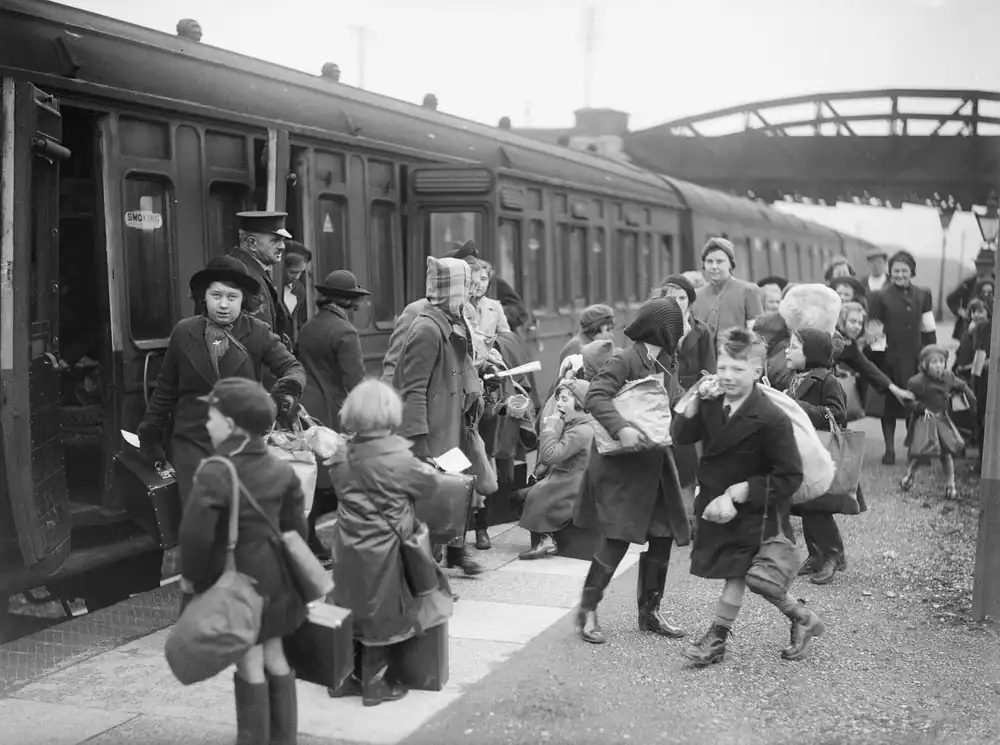
Illustrative: evacuated children from Bristol arriving at a station in Devon in 1940. Similar scenes took place at Harpenden and St Albans stations.
Photo: Ministry of Information Photo Division, Imperial War Museums (D 2592). Public domain.
Some evacuees had never seen the countryside. One arrived at his new home, looked out of the window and saw a cornfield for the first time. Two London boys tried to walk home and got as far as Barnet before the police caught them.
Hospital patients were also evacuated to the city. Sylvia Glossop, daughter of Canon Glossop of the Cathedral, who had won a Red Cross medal in the First World War, set up the St Albans Joint Voluntary Nursing Services to staff local hospitals taking patients from St Bartholomew's in London.
The bombs
Only 10 people were killed in air raids in the St Albans area during the whole war. November 1940 was the worst month, when 60 bombs fell on the city and 10 people died. Many other bombs fell on farmland or failed to explode. The first casualty of the raids in St Albans was a cow at Hedges Farm.
Industry and austerity
Local industry was turned to the war effort. The Ballito hosiery factory in Fleetville switched to making ammunition, with day and night shifts that kept the production line running. It also made parts for the Hatfield and Leavesden aircraft factories, which built De Havilland Mosquitos, and for radar equipment. Because stockings were scarce, women stained their legs with gravy browning and drew a line up the back to look like a seam.
Clothes rationing arrived in 1941, with 66 coupons per person for a year. A coat cost 18, a frock 10 to 12, and a pair of stockings six. Sweets were rationed to three ounces a week. People were told to run no more than five inches of hot water in the bath. Local conscientious objectors played their part by working with the Women's Land Army at the Hertfordshire College of Agriculture, now Oaklands.
The secret war
St Albans also hosted hidden operations, many of which only became known years afterwards.
- Gorhambury House — A base for the Special Operations Executive, created in 1940 to spy, sabotage and carry out reconnaissance in occupied Europe
- Glenalmond House, King Harry Lane — Used by the Secret Intelligence Service, led by Kim Philby, with a cover story that archaeologists from Verulamium lived there
- Woodcock Hill, near Sandridge — A radio station with over 100 operators who tracked suspected enemy transmissions and sent intercepts to Bletchley Park by motorcycle courier
- Ballito factory, Fleetville — Ammunition and aircraft parts
One of the strangest episodes came in May 1941. A man emerged from a wood near London Colney, where he had buried a parachute, a radio transmitter and food. He was a German agent named Karl Richter, who had parachuted into a field and hidden for nearly two days. His bad luck was a lost lorry driver, who stopped to ask him for directions and then mentioned the unhelpful stranger to a police constable. Constable Scott followed Richter, questioned him and took him to the police station.
Adding the names
When the war ended, 162 new names were added to the memorial in front of St Peter's, according to a local account, though the Imperial War Museums' memorial register gives 168. Men who returned found a battered nation with shortages of almost everything. Rationing continued, and Britain was deep in debt.
St Albans Tour Guides offer a guided walk around the street memorials in the days around Remembrance, and past walks have raised money for the British Legion. Details are on the St Albans Tour Guides website.
Keep reading
Previous: ← 1939 to 1945: Harpenden at War
Next: Adding the Second World War Names →
📖 Read the whole illustrated book. Turn the pages like a real book, or swipe on your phone.
All 13 parts
- Introduction: Why We Remember
- August 1914: Two Towns Go to War
- Harpenden in the Great War: Camp, Hospital and Home Front
- St Albans in the Great War: A Garrison Town
- The Fallen: The People Behind the Names
- Building Memory: The Memorials of 1920 and 1921
- The Street Memorials of the Abbey Parish
- Private Edward Warner VC: The Straw Hat Maker from Cannon Street
- Between the Wars: Learning the Ritual
- 1939 to 1945: Harpenden at War
- 1939 to 1945: St Albans at War (you are here)
- Adding the Second World War Names
- Remembrance Today: Services and Walks
From you, for your neighbours
Share your story
Have a story from your street, your family or your town? Write it up and share it with us, and we'll publish it for your neighbours. It's free, and you don't need to be a writer.
- Local history
- Family and street memories
- Places and walks
- People and profiles
- Food, drink and traditions
- Old photos and keepsakes
A good story usually has
- A clear title
- Your own words
- Which town
- Names and dates, if you have them
- Photos you own or can share